Artistic Gymnastics Scoring Explained
Artistic gymnastics at the Commonwealth Games involves a scoring system that balances difficulty and execution. Two primary scores are used: the ‘D-score’ for difficulty and the ‘E-score’ for execution. Both scores are determined by panels of multinational judges approved by the International Gymnastics Federation (FIG).
The D-score begins at zero and increases based on the complexity of the routine, with no upper limit. This score is derived from predetermined values for various elements outlined in the FIG Code of Points, ranging from A-grade ‘basic’ skills to H-J grade ‘exceptional’ pioneering moves. Points are also awarded for routine composition and the seamless connection of skills.
In contrast, the E-score starts at a perfect 10, with points deducted for errors. Small errors, such as a minor loss of balance, result in a 0.1-point deduction. Medium errors, like a significant loss of balance, incur a 0.3-point deduction, while large errors, such as deep squats on landing, lead to a 0.5-point deduction. Major errors, including falls, result in a 1.0-point deduction. The vault event is an exception, where each routine has a pre-determined D-score, and only the E-score is judged.
Neutral deductions are applied after combining the D and E-scores. These deductions account for errors unrelated to the routine itself, such as stepping out of bounds, exceeding the allocated routine time, or outfit violations. For a medal-winning performance, gymnasts typically aim for scores in the 14s and 15s, with world-class routines potentially reaching into the high 15s or low 16s.
Men’s and Women’s Disciplines
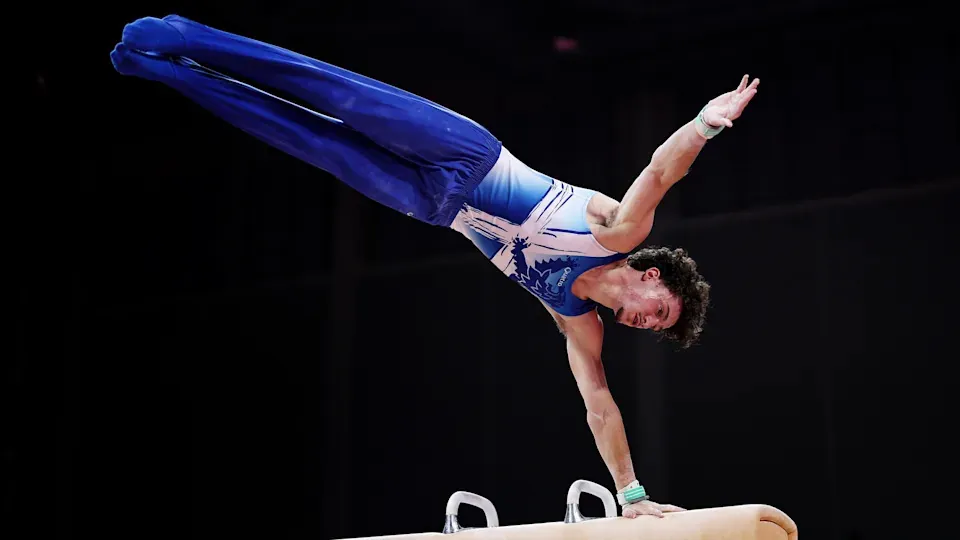
Men and women compete in different events within artistic gymnastics. Men’s events include the pommel horse, rings, parallel bars, and horizontal bar. Women’s events are the uneven bars and balance beam. Both men and women compete in the vault and floor exercise.
In the men’s all-around competition, athletes are judged across six events, while women’s all-around scores are based on four events. Women are judged on their top eight highest-scoring skills, whereas men are judged on 10. Women’s floor and beam routines also receive marks for ‘artistry,’ which includes elements like expression, confidence, personal style, and varied tempo. Men’s floor routines do not include music, but gymnasts can still incorporate elements to demonstrate originality and creativity. Additionally, the women’s vault apparatus is set at a lower height than the men’s.
Team Event Scoring
Artistic gymnastics team events use the same scoring principles as individual events, but the scores are aggregated differently. At least two athletes from each nation participate in each apparatus event. Their individual scores are then combined to form the overall team score. If three athletes compete in a discipline, the two highest-scoring routines contribute to the team’s total score.
At the 2026 Commonwealth Games, Team Scotland had a strong start in artistic gymnastics, with Reuben Ward securing the nation’s first gold medal in the men’s all-around. England also earned a bronze medal, and Wales placed fourth in the women’s all-around team event. Canada’s Félix Dolci won silver in the men’s all-around final, scoring 79.450, while Ellie Black of Canada became the first gymnast to win two all-around crowns at the Games, with a winning score of 53.050.
During the competition, Gabriel Langton, an English gymnast, sustained a fall from the high bars. He was later seen supporting his teammates, including Ward, who remembered the encouragement to “Do it for Gabe.” Singapore’s Jovi Loh was also taken off on a stretcher after a knee injury during his routine on the bars.
The Commonwealth Games are scheduled to continue through August 2.
Source: ca.sports.yahoo.com